Make Funny Faces the Japanese House
The English language give-and-take habitation does not have a Japanese equivalent simply links to diverse terms and concepts: ie and katei relate to the business firm spatially; kazoku (equanimous of the characters for house and tribe) is the immediate family and household; furusato defines a nostalgic epitome of one's domicile, hometown, or birthplace. Just as the Japanese linguistic communication is highly situational, the thought of home too depends on the context. It is therefore not surprising that the motif of the home in Japanese photography is diverse, raising compelling questions: How exercise architectural photographs present the Japanese dwelling? Are Daido Moriyama'due south blurry 1970s images of the hamlet of Tono linked to a hometown vision? What kind of family domicile practice younger photographers portray in their work?

Courtesy Kochi Prefecture, Ishimoto Yasuhiro Photo Centre and the drove of the Museum of Art, Kochi
Ie : Home as a business firm
Yoshio Watanabe, best known for his 1953 Ise shrine photographs, and Yasuhiro Ishimoto, who studied at the Institute of Design in Chicago earlier returning to Nippon in 1953, were both concerned with the traditional architecture of Japanese temples, shrines, and villas. Unlike the Western idea of architecture that is durable and permanent, it has been a long custom in Japan to constantly modify and copy space, for instance through the utilize of sliding doors and futon beds that are stored away during the day and taken out at night. In Watanabe's Japanese architecture photographs and Ishimoto'due south meticulously composedKatsura Imperial Villa series (1953–82), sliding newspaper doors and low-cal tatami flooring contrast with nighttime wooden pillars; architectural shapes are captured as articulate lines and geometric forms reminiscent of the Bauhaus (which in turn was partly inspired by a Japanese "purist" style). No item is unplanned—forms and materials are in harmonious dialogue. The minimal, nigh abstract photographic compositions convey a feeling of rest. The homes that Ishimoto and Watanabe present u.s. with can exist viewed as manifestations of the Japanese philosophy of infinite known every bit ma, literally "in-between." The artful of the rooms (and of the photographs) comes into existence through a careful interaction between form and non-grade, dark and light. The transient concept of space can be seen as following the tradition of Shinto and Buddhist civilization, emphasizing the impermanence of all things.

Courtesy the Tertiary Gallery Aya, Osaka
Impermanence is also evident in a small city room in which paint is peeling off a sliding window frame. A pair of gloves, ii umbrellas, and a kettle are attached to a laundry line strung beyond the room. It is the year 1978, and this home in Tokyo is 1 of manythat Ishiuchi Miyako captured with her handheld camera. The dark gelatin-silver prints testify some apartments with and others without their inhabitants. They were published in Ishiuchi'south first photography volume, Apartment (1978). In 1979, to her surprise, she received the renowned Kimura Ihei Award for this series. At the time, Japan was characterized by a fast-growing economy, which resulted in the area around Tokyo becoming increasingly urbanized. Residential buildings were erected speedily and cheaply. Apartment documents people's uncomplicated, provisional living conditions, oftentimes in temporary homes. The photographs cannot be separated from the photographer's personal memories, as she lived in a similar flat in Yokosuka on Tokyo Bay between the ages of six and nineteen. She has repeatedly told me how she hated growing upward at that place. The apartments symbolize her own childhood home. "I wanted to render to all the places that I associated with bad memories," she said. She has also described the apartments as being "permeated by a mix of different body smells. I have the feeling that the apartments odour thoroughly like people. These apartments are small, dark, and somewhat dirty, and nobody wants to live in them. Merely I sense a sure kind of reality in them—they are places that feel very human." Her Apartment photographs are "human" primarily because they make visible the traces of their countless erstwhile inhabitants. Walls are covered in cracks, sweat stains, and fingerprints. Objects suggest stories about their owners. Every bit in Ishiuchi's after works depicting human bodies, apparel, or objects that people accept left behind subsequently their deaths, these poetic images tell of people, their bloodshed, and bittersweet remembrance.
Courtesy the artist
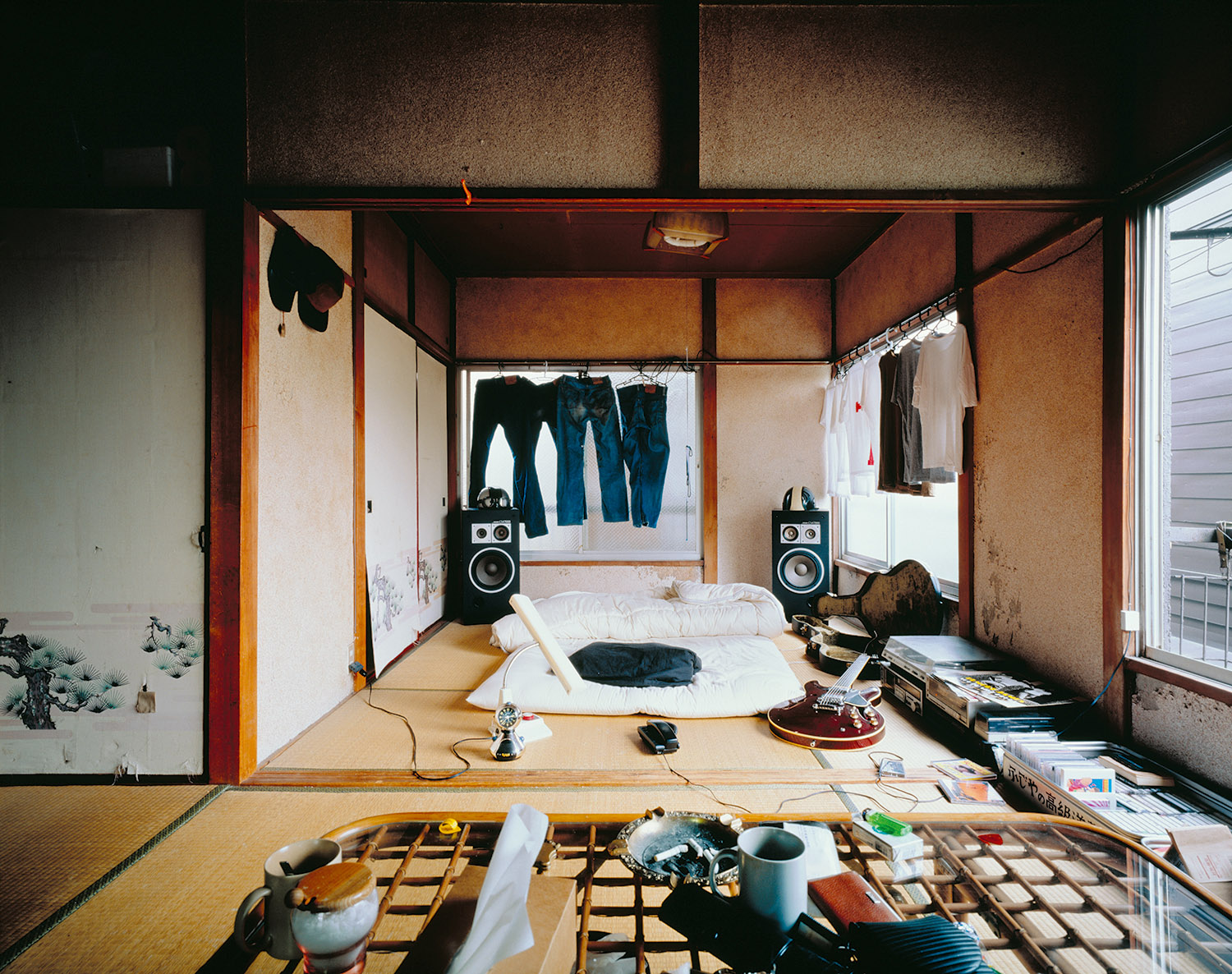
In 1993, the photojournalist Kyoichi Tsuzuki published a small-format book, Tokyo Style, that also documented small homes. Compared to Ishiuchi, all the same, Tsuzuki is less interested in the memories captured in rooms. Rather, his photographs of approximately ane hundred apartments are concerned with everyday, real interiors. In 1 image, an electrical guitar and large speakers dissimilarity with traditional tatami flooring. Clothes are provisionally hung on a curtain runway. Using a big-format photographic camera, Tsuzuki carefully constructs his photographs, presenting them with brusk descriptions about the rooms and their interior design or cardinal piece of furniture pieces, offering the same viewpoint on these inexpensive studio apartments as we might see on stylish apartments designed by famous architects. His now-iconic book was a reaction against the staged photographs of designer apartments constitute in interior design magazines and java-table books. When I spoke with Tsuzuki, he laughed about such fantasies and the "flowers that are usually not there, or fruit that nobody ever eats, and the interior designer who would also be at the photo shoot." Such magazine photographs, and mayhap likewise the visual legacies of figures such every bit Ishimoto or Watanabe, have resulted in a stereotype of Japanese people living in Zen-inspired minimalist homes. "Although the neat majority, effectually 9 out of ten people in Tokyo alive in tiny apartments, including members of staff that create beautiful architectural magazines, there was not a single book about their rooms," Tsuzuki said.

Daido Moriyama Photo Foundation
Furusato : Longing for habitation
In 1909, when the author and ethnologist Kunio Yanagita visited the isolated village of Tono in northeastern Japan, it was mainly inhabited past peasants, and the first railroads were only starting to be constructed. Seeking to record the rural lifestyle and folk beliefs, Yanagita collected oral stories by the folklorist Kizen Sasaki The legends were published in a 1910 volume titled Tono Monogatari (The Tales of Tono), revealing a dark earth of the fantastic and reflecting a history of astringent human existence. In the late 1960s and '70s, a wide interest in Japanese sociology began to emerge, and Yanagita's piece of work was rediscovered. With the growth in prosperity, a concern with traditions institute its style into people's leisure life, as evident in the increasing number of cultural centers offering courses in all kinds of "accurate" Japanese arts. Within the gimmicky challenges—enormous economic growth and internationalization on the 1 mitt, student revolutions and protests against the 1960 Nihon–United States Security Treaty on the other—nostalgic ideas of a "traditional" Japan ensured a familiar national and cultural identity. Moriyama's photography volume Tono Monogatari (1976) and Masatoshi Naito's Tono Monogatari (published in 1983 but photographed between 1971 and 1982) reverberate Japan's folklore boom. Moriyama's and Naito'southward generally blackness-and-white photographs of Tono, with their stark contrasts and dark imagery, convey a sense of the mysterious. Moriyama's blurry, grainy images taken out of the train window on his journey to Tono or his cropped colour photographs of flowers in someone'south garden, as well every bit Naito's photographs of Tono at night, shot with a flash, advise scenes that all of a sudden appear and so vanish again—just like indeterminate visual recollections unexpectedly surfacing from the night realms of memory.

Courtesy the artist and Yumiko Chiba Associates
In Moriyama's photobook descriptions of his journey, the term furusato plays a major role. The modern notion of furusato (literally "old village") refers to one's native place and is associated with nostalgic, warm feelings. Peradventure information technology is best described by the philosopher Ernst Bloch'due south famous words virtually the abode as a place that "shines into the childhood of all and in which no one has yet been." At that place is a stiff temporal component to furusato: it is linked with an image of the past, constituting a sentimental antithesis to the present. In the 1970s, Tono became regarded equally an example of furusato: a warmly pastoral home that functioned as a romantic counterpoint to the prosperous, fast-paced, and Westernized Japan of the present. As the folklore scholar Hermann Bausinger once said, the expansion of the term home tends to coincide with the dissolution of one'due south horizon. The loss of the war and the large-scale sociopolitical and economic changes since 1945 had surely dissolved Japan'southward former horizon, resulting in a fundamental severance from dwelling. Information technology was this alienation from dwelling that led to Japanese artists' new concern with the idea. Moriyama writes nigh his wistful longing for Tono as an embodiment of furusato, which he defines as a "swollen utopia of countless babyhood memory fragments." Both Moriyama and Naito refer to the idea of the hometown as a "primordial image" in our subconscious, using a term coined by the psychoanalyst Carl Jung that defines images from the collective unconscious, shared among all humans. Moriyama confronts his hometown utopia by interacting with the real Tono through his camera. The medium of photography helps him to overcome, at least momentarily, his melancholic search for a home. When Moriyama leaves, he is able to say, "Tono, farewell for now."

Courtesy the artist and Zen Foto Gallery, Tokyo
Kazoku : Home means family
Sometimes home is neither a particular place nor a distant memory. Funabashi Story, a series of images taken by Kazuo Kitai between 1983 and 1987, beautifully records people's mundane lives inside apartment complexes in Funabashi, a city on the outskirts of Tokyo that grew rapidly in the 1980s. 1 of the protagonists is a kid behind transparent curtains, curiously looking out a window while the television is on. The photographs have a narrative quality, and when Kitai published them as a photobook in 1989, he added texts that describe the homes and people'southward domestic habits. "I decided to accept photographs considering I wanted to bear witness people's lives and hear their stories," he told me, emphasizing that his viewpoint is not neutral but always aligns with the photographic subjects' position. Kitai's sincere respect for the residents is evident in his Funabashi Story photographs.
Yurie Nagashima, Takashi Homma, and, most recently, Motoyuki Daifu and Masaki Yamamoto have presented personal stories about their families. Nagashima first received attention in the male-dominated Japanese photography scene in 1993, as a young adult female who portrayed herself and her family naked at home. They appear comfortably unclothed when posing for a family unit photograph or pursuing their daily routines. "I grew upward in a free and open family environment, in quite a downtown style," she said. "My family unit would walk effectually one-half naked with only a towel around their bodies after taking a bath. To me, nakedness is not necessarily something sexual."

Courtesy the artist
In his photobook Tokyo and My Daughter (2006), Homma portrays the nonglamorous and domestic, interweaving photographs of his studio with a portrait of a small dog and photographs of a young girl who appears to exist exposed to the loving eyes of her proud male parent. We see her grow from a toddler to an uncomplicated-schoolhouse child. In one photograph, she appears wearing the same shirt as Homma, who is checking the inside of a refrigerator in the back- ground. The daughter stares straight into the camera, suggesting that she is aware of the viewer while besides looking bored. The sequence of images conveys a diaristic feeling. With this book, Homma has shifted his attention from the formalistic suburban landscape to the closeness of the habitation space. The fact that the photographic story is fictional (the daughter in the series is the lensman'south friend'due south girl) is not visible in the work: the book presents itself assuredly as a personal portrait of a father and a girl'southward life in the city.
Homma's vision of a eye-class home contrasts with the cluttered, much more modest apartment in Kobe that Yamamoto has captured in a real and movingly intimate family portrait. Their tiny home, explored in his affectionate photobook GUTS (2017), is jam-packed with clothes, plates of nutrient, cans, paper, and countless household objects. In betwixt all this clutter, members of Yamamoto'south family are lying on the floor: sleeping shut together, watching television, playing video games, and enjoying each other's company. The young photographer seems to tell united states that home is, above all, where one's center is—with 1's family and loved ones.
Read more from Discontinuity, consequence 238, "House & Home," or subscribe to Discontinuity and never miss an upshot.
Source: https://aperture.org/editorial/home-japanese-photography/
0 Response to "Make Funny Faces the Japanese House"
Post a Comment